Both arguments miss the commercial reality. For a local business, Google Ads and SEO are not competitors—they are distinct financial tools designed to solve entirely different operational problems. SEO vs. Google Ads for Local Business
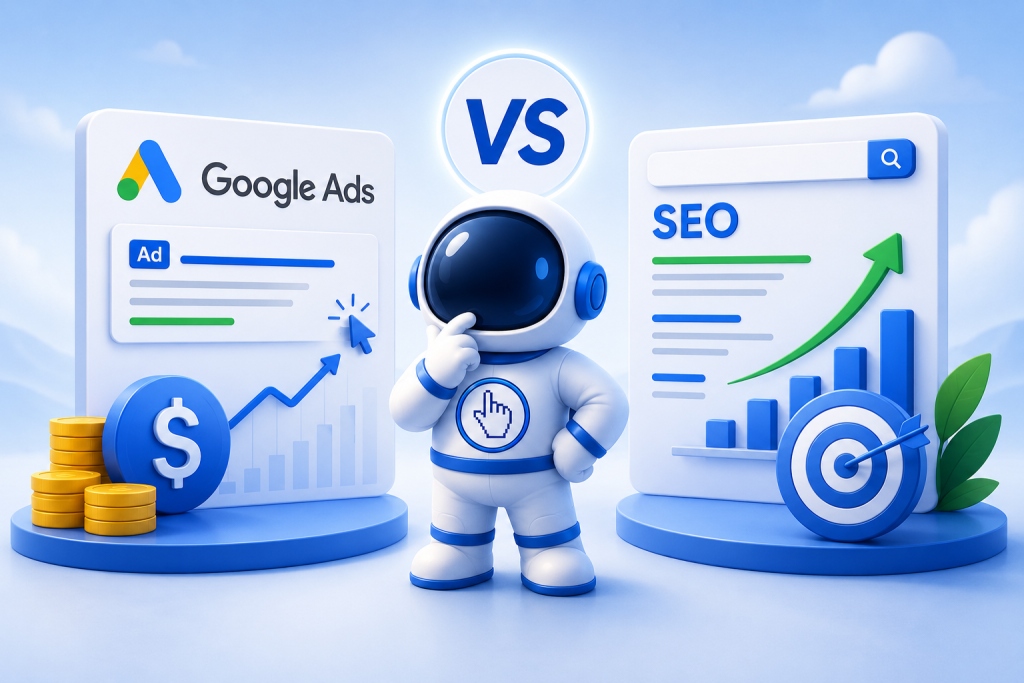
SEO vs. Google Ads for Local Business
Where Should Your Budget Actually Go?
If you run a local business, you face the same fundamental marketing challenge every month: how to generate a steady, predictable pipeline of qualified inquiries without burning cash on unqualified clicks.
Inevitably, the debate lands on two major channels: Google Ads and Local SEO.
Agency sales pitches often present this as an ideological battle. Paid advertising specialists argue that SEO takes too long, while organic search advocates dismiss ads as an unsustainable money pit.
Here is a practical, no-nonsense breakdown of how each channel functions, their true commercial trade-offs, and how to allocate your capital effectively.
Google Ads: Renting Instant Market Access
Google Ads operates like a utility tap: the moment you turn it on and fund it, qualified search traffic flows to your website. The moment you stop paying, the tap turns off immediately.
The Commercial Advantages
- Immediate Speed to Market: If you are launching a new local service, entering a new territory, or filling a sudden dip in your pipeline, Google Ads can put your offer at the top of search results within hours.
- Granular Commercial Control: You control the exact search queries you pay for, the geographic radius where ads appear, the specific landing pages visitors see, and your maximum daily expenditure.
- Testing Ground for Conversion: Paid search is an invaluable tool for validating market demand. You can test which service angles, headlines, and value propositions convert into paying customers before investing months into building organic content around them.
The Strategic Limitations
- Pure Operating Expense (Zero Equity): Paid traffic does not build long-term enterprise value. You do not own the visibility; you are renting commercial space.
- Rising Cost-Per-Click (CPC): In competitive local service categories, ad auctions become more expensive every year as competitors bid aggressively on high-intent terms.
- Consumer Ad Skepticism: A measurable portion of discerning searchers deliberately scroll past sponsored listings to click on organic results or verified local map listings, which carry greater perceived credibility.
Local SEO: Building Digital Real Estate
Local SEO is the process of establishing entity authority, geographic relevance, and search consensus across Google Search and Maps. Instead of renting individual visits, you are investing in a proprietary commercial asset.
The Commercial Advantages
- Compounding Financial ROI: The primary advantage of organic visibility is margin expansion. While building rank requires upfront investment, the marginal cost of each additional visitor is effectively zero. A dominant presence in the local map pack generates leads around the clock without an ongoing per-click toll.
- Higher Inherent Trust: Local buyers understand that anyone with a credit card can run an ad. Securing a top position in local organic search or the Google Maps 3-Pack signals verified longevity, real customer satisfaction, and community authority.
- Future-Proofing for AI Retrieval: Emerging search platforms and AI-driven answer engines rely heavily on organic public signals, third-party directory consensus, and structured web data to choose which businesses to recommend. Paid ad spend does not buy inclusion in AI-generated answers.
The Strategic Limitations
- Requires a Lead Time: Genuine organic authority cannot be bought overnight. Aligning technical architecture, publishing authoritative localized content, and earning third-party consensus takes deliberate execution over several months.
- Requires Ongoing Maintenance: Search engine algorithms evolve continually. Maintaining a dominant local market position requires ongoing attention to technical health, content freshness, and reputation management.